
10 Best Mass Email Marketing Services to Grow Your Business
June 18, 2026
Email Sender Reputation: A Complete Guide to Better Deliverability
July 10, 2026Are your bulk emails going to the spam folder instead of the inbox? Are you spending money on email marketing but still getting low open rates and poor results? Many businesses face this problem without even knowing that their IP setup could be the real reason behind it. Choosing the wrong IP type can hurt your email deliverability, damage your sender reputation, and reduce the success of your bulk email campaigns.
When businesses start email marketing, one common question always comes up, should you choose a dedicated IP vs shared IP? What is the real difference between dedicated IP vs shared IP? And which option is better for long-term email marketing success?
Email marketing is one of the most powerful ways to connect with customers, promote offers, share updates, and grow your business. But when sending large numbers of emails, your IP reputation becomes extremely important. A good IP setup can help your emails reach the inbox, while a bad one can push your emails directly into spam.
In this easy-to-understand guide by DigitalAka, we will explain everything about shared vs dedicated IP, how both work, their pros and cons, and which one is best for your bulk email campaigns, all in very simple English anyone can understand easily.
Table of Contents
What Is an IP Address in Email Marketing?
An IP address in email marketing is the server address used to send emails. Every email you send passes through an IP address, and email providers like Gmail, Yahoo, Outlook, and Apple Mail use this IP to track your sending behavior and reputation.
Think of an IP address like a digital identity for your email campaigns. Just like a business reputation matters in real life, your IP reputation matters in email marketing.
Whenever you send bulk emails, email providers analyze factors like:
- How many emails you send
- How often you send emails
- Spam complaints
- Bounce rates
- User engagement
- Open and click rates
- Email authentication setup
Based on this behavior, they decide whether your emails should:
- Reach the inbox
- Go to the promotions tab
- Land in the spam folder
- Or get blocked completely
This is why IP reputation plays a major role in successful email marketing campaigns.
A strong and clean IP reputation can help improve:
- Email deliverability
- Inbox placement
- Sender reputation
- Spam score
- Open rates
- Click-through rates
- Overall campaign performance
On the other hand, a poor IP reputation can reduce your email visibility and affect lead generation and sales.
For businesses running bulk email campaigns, choosing the right IP setup is extremely important because it directly impacts deliverability and ROI.
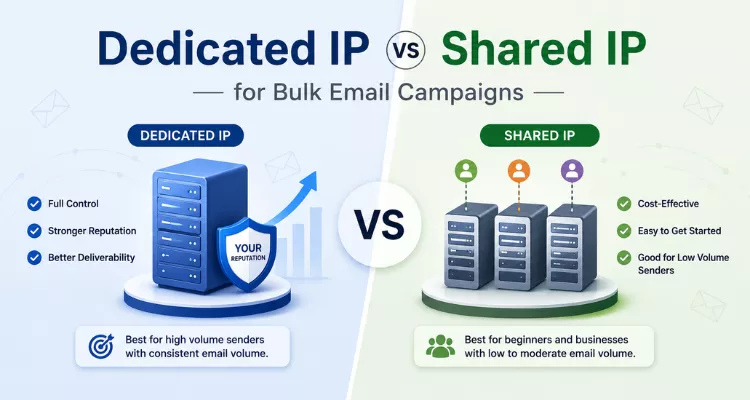
There are mainly two types of email IPs used in bulk email marketing:
1. Shared IP
A Shared IP is used by multiple businesses or users at the same time. The reputation of the IP is shared among all users on that server.
2. Dedicated IP
A Dedicated IP is used by only one business. This gives full control over email reputation, sending practices, and deliverability performance.
Both options have their own advantages and disadvantages depending on your email volume, business size, and marketing goals.
Let’s understand both dedicated IP vs shared IP in detail.
Read More- 10 Best Mass Email Marketing Services
What is a Shared IP?
A Shared IP means multiple users or businesses use the same IP address to send emails. For example, if 100 companies are using one SMTP server, all their emails are sent through the same IP address. This means the sender reputation of that IP is shared among all users connected to the server.
Shared IPs are commonly used by many email marketing platforms because they are cost-effective and easy to manage. Small businesses, startups, and beginners often start with shared IPs before moving to dedicated infrastructure. In a shared environment, email providers like Gmail and Outlook evaluate the combined sending behavior of all users on that IP. If most users follow good email practices, the IP can maintain a healthy reputation. However, if some users send spam or low-quality emails, it can affect everyone using that IP. Despite this limitation, shared IPs are still a popular choice for businesses with lower email sending volumes.
Benefits of Shared IP
1. Lower Cost
Shared IPs are usually more affordable because multiple users share the same server resources and infrastructure costs.
This makes them a budget-friendly option for:
- Small businesses
- Startups
- Beginners in email marketing
- Businesses with limited email volume
2. Good for Beginners
If you send a low volume of emails, a shared IP can work very well.
Businesses that send:
- Monthly newsletters
- Small promotional campaigns
- Basic customer updates
usually do not need a dedicated IP in the beginning.
3. No Warm-Up Required
One major advantage of a shared IP is that it already has an established sending history and reputation.
With a new dedicated IP, businesses need to slowly increase email volume over time. But with shared IPs, you can often start sending campaigns immediately.
4. Easier Setup
Shared IP environments are usually managed by the email service provider, making setup simple and beginner-friendly.
Most technical tasks like:
- Server management
- IP monitoring
- Infrastructure maintenance
- Reputation handling
are handled by the provider.
This allows businesses to focus more on email campaigns rather than technical configuration.
5. Suitable for Low Email Volume
Shared IPs are ideal for businesses that send emails occasionally or in smaller quantities.
If your sending frequency is inconsistent, a shared IP may perform better because dedicated IPs usually require regular sending activity to maintain reputation.
6. Managed Reputation Support
Many professional email service providers actively monitor shared IP reputation and remove bad senders to maintain overall deliverability.
This helps maintain stable performance for responsible users sharing the IP.
Read More- Email Marketing Trends in 2026
Disadvantages of Shared IP
While shared IPs are affordable and beginner-friendly, they also come with several limitations that can affect your email marketing performance, especially for businesses sending bulk campaigns regularly.
Because multiple users share the same IP address, your email reputation is not completely under your control. Even if you follow proper email marketing practices, the actions of other users on the same server can still impact your deliverability.
Let’s understand the major disadvantages of shared IPs in detail.
1. Reputation Depends on Other Users
The biggest issue with a shared IP is that your sender reputation depends on everyone using that IP address.
If another business on the same server:
- Sends spam emails
- Buys email lists
- Gets high spam complaints
- Has poor email practices
then the overall reputation of that IP can get damaged.
As a result, your emails may also start:
- Landing in spam folders
- Facing lower inbox placement
- Getting blocked by email providers
Even if your campaigns are completely legitimate, you can still be affected because the IP reputation is shared among all users.
2. Higher Risk of Spam Placement
Shared IPs usually have a higher risk of spam placement compared to dedicated IPs.
Email providers like Gmail and Outlook continuously monitor sending behavior from each IP address. If suspicious activity is detected from any user sharing that IP, trust can decrease for the entire server.
This can reduce inbox placement rates for everyone using the shared IP.
Common problems may include:
- Emails going to Promotions or Spam folders
- Lower open rates
- Reduced engagement
- Delayed email delivery
This risk becomes even higher on low-quality shared servers where providers do not properly monitor users.
3. Limited Control
With a shared IP, you do not have full control over:
- Sender reputation
- Server performance
- IP quality
- Other users’ behavior
- Deliverability management
Even if you maintain excellent email practices, you still rely on the email service provider to manage the server properly.
You also cannot fully control:
- Sending limits
- Reputation recovery
- Blacklist issues
- Server configuration
This lack of control can become a problem for businesses that rely heavily on email marketing for leads and sales.
4. Performance Fluctuations
Deliverability performance on shared IPs can change anytime because of activities from other users sharing the server.
One day your emails may achieve strong inbox placement, while another day performance may suddenly drop due to:
- Spam complaints from another sender
- Blacklisting issues
- Sudden spikes in sending volume
- Poor email practices by shared users
These fluctuations can make campaign performance unpredictable.
For businesses running large-scale email marketing campaigns, inconsistent deliverability can directly affect:
- Lead generation
- Revenue
- Customer engagement
- Marketing ROI
5. Possible Blacklisting Issues
If too many users on a shared IP engage in spam-like activities, the IP address may get blacklisted by email providers or spam monitoring organizations.
Once an IP is blacklisted:
- Emails may bounce
- Inbox placement may drop significantly
- Campaign performance may suffer
Recovering from blacklisting can take time and may impact all users on the shared server.
6. Not Ideal for High-Volume Email Campaigns
Businesses sending large email volumes often outgrow shared IP environments.
As email volume increases, businesses usually need:
- More reputation control
- Stable deliverability
- Better inbox placement
- Dedicated infrastructure
Shared IPs may not provide the consistency needed for professional bulk email marketing operations.
For this reason, many growing businesses eventually switch from shared IPs to dedicated IP solutions.
Read More- Top 10 Email Marketing Platforms for Maximize ROI
What is a Dedicated IP?
A Dedicated IP means the IP address is used only by your business for sending emails.
No other company, marketer, or sender shares that IP address with you. This gives your business complete ownership and control over email sending activities and reputation management.
Unlike shared IP environments, where multiple users affect the same reputation, a dedicated IP allows you to build your own sender reputation based entirely on your email practices.
This is one of the main reasons why businesses running professional bulk email campaigns often prefer dedicated email infrastructure.
With a dedicated IP, email providers like Gmail, Yahoo, Outlook, and Apple Mail evaluate only your behavior, including:
- Email quality
- Sending frequency
- Spam complaint rates
- Bounce rates
- User engagement
- Authentication setup
- Overall sender consistency
If you maintain good email practices, your IP reputation becomes stronger over time, which can improve inbox placement and campaign performance.
Dedicated IPs are commonly used by:
- Bulk email marketers
- E-commerce brands
- SaaS companies
- Agencies
- Large businesses
- Newsletter publishers
- Transactional email senders
Especially businesses that send high-volume email campaigns regularly.
Benefits of Dedicated IP
1. Full Control Over Reputation
With a dedicated IP, your sender reputation depends only on your own email practices.
You are not affected by the activities of other businesses or marketers because the IP belongs only to you.
This gives you complete control over:
- Sending behavior
- Email quality
- Reputation management
- Deliverability optimization
If you consistently send high-quality and permission-based emails, email providers gradually build trust in your IP address.
Over time, this can help improve:
- Inbox placement
- Open rates
- Sender credibility
- Email engagement
Good email campaigns help create a strong and stable reputation with email providers.
2. Better Deliverability
One of the biggest advantages of a dedicated IP is improved email deliverability.
Businesses that follow proper email marketing practices usually achieve:
- Better inbox placement
- Lower spam folder rates
- Higher email acceptance
- More consistent delivery performance
Since the IP reputation is fully under your control, there is less risk of deliverability problems caused by other users.
This is especially important for businesses where email marketing directly impacts:
- Sales
- Lead generation
- Customer communication
- Revenue growth
A strong dedicated IP reputation can significantly improve overall campaign performance.
3. More Stable Performance
With a dedicated IP, your email performance remains more stable and predictable.
You are not affected by:
- Spam activity from other users
- Poor-quality senders
- Shared server blacklisting
- Sudden reputation drops caused by third parties
This creates a more reliable email marketing environment.
Businesses using dedicated IPs often experience:
- Consistent inbox rates
- Stable sending reputation
- Better long-term deliverability
- Improved engagement metrics
For professional marketers, this stability is extremely valuable.
4. Ideal for High Email Volume
Dedicated IPs are perfect for businesses sending large email volumes regularly.
This includes:
- Bulk email campaigns
- Promotional emails
- Transactional emails
- Newsletters
- Automated workflows
- Customer updates
- Marketing sequences
Dedicated IPs are especially recommended for businesses sending over 50,000+ emails per month.
High-volume senders benefit from:
- Better scalability
- More reputation control
- Improved deliverability consistency
- Greater campaign reliability
As your business grows, a dedicated IP provides the infrastructure needed for long-term email marketing success.
5. Better Brand Trust
Email service providers tend to trust businesses with strong sending behavior and properly configured dedicated servers.
A dedicated IP combined with proper setup can improve brand credibility and trust signals.
This includes:
- SPF configuration
- DKIM authentication
- DMARC protection
- Clean email lists
- Consistent sending patterns
When email providers see stable and professional sending behavior, they are more likely to deliver emails directly to the inbox.
This helps businesses build:
- Better customer trust
- Stronger communication reliability
- Improved engagement
- Long-term sender reputation
6. Better Monitoring and Analytics
Dedicated IPs also allow businesses to monitor email performance more accurately.
Since the IP is used only by your business, you can clearly analyze:
- Bounce rates
- Spam complaints
- Open rates
- Click-through rates
- Reputation scores
- Deliverability trends
This makes it easier to optimize campaigns and identify problems quickly.
7. More Suitable for Professional Email Marketing
Businesses serious about long-term email marketing growth often move toward dedicated infrastructure because it offers:
- Better control
- Higher reliability
- Improved performance
- Stronger deliverability
- Better scalability
For brands heavily dependent on bulk email campaigns, dedicated IPs provide a more professional and stable solution compared to shared IP environments.
Disadvantages of Dedicated IP
While dedicated IPs offer better control, stronger reputation management, and improved deliverability, they also come with certain challenges. Businesses using dedicated email infrastructure need to manage their email practices carefully to maintain a healthy sender reputation.
For beginners or low-volume senders, dedicated IPs may require more effort and investment compared to shared IP environments.
Let’s understand the main disadvantages of dedicated IPs in detail.
1. Higher Cost
Dedicated servers and IPs are usually more expensive than shared IP solutions.
Since the infrastructure is reserved only for your business, you are responsible for the full cost of:
- Server resources
- IP management
- Monitoring tools
- Security setup
- Email infrastructure maintenance
Additional costs may also include:
- Dedicated SMTP servers
- Deliverability monitoring tools
- Authentication setup
- Technical support
- IP reputation management
For small businesses or beginners with low email volume, these costs may not always be necessary in the early stages.
However, for businesses running large-scale email campaigns, the long-term benefits of dedicated IPs often outweigh the higher cost.
2. Requires IP Warm-Up
One of the biggest challenges with a new dedicated IP is the warm-up process.
When an IP address is brand new, email providers do not yet trust it because there is no sending history attached to it.
To build trust, businesses must gradually increase their email sending volume over time. This process is known as IP Warm-Up.
For example:
- Start by sending a small number of emails
- Gradually increase volume daily or weekly
- Maintain good engagement and low complaint rates
This helps email providers recognize the IP as trustworthy.
If businesses suddenly send large volumes from a new IP without warming it up properly, it may:
- Trigger spam filters
- Reduce deliverability
- Cause emails to land in spam folders
- Damage IP reputation early
IP warm-up requires patience, planning, and proper campaign management.
3. Requires Proper Email Practices
With a dedicated IP, your reputation depends entirely on your own email behavior.
If you send:
- Spam emails
- Purchased email lists
- Low-quality campaigns
- Misleading subject lines
- Unwanted emails
your IP reputation can quickly become damaged.
Unlike shared IPs, there are no other users to balance the reputation. Every action directly impacts your own deliverability.
Dedicated IP vs Shared IP: Main Differences
| Feature | Shared IP | Dedicated IP |
| IP Usage | Shared by multiple users | Used by one business only |
| Cost | Lower | Higher |
| Reputation Control | Limited | Full control |
| Deliverability Stability | Can fluctuate | More stable |
| Best For | Small senders | High-volume senders |
| Warm-Up Needed | Usually no | Yes |
| Risk From Other Users | High | None |
| Customization | Limited | More control |
Shared vs Dedicated IP: Which One is Better?
When comparing Shared vs Dedicated IP, there is no single answer that works for every business.
The right choice mainly depends on:
- Your email sending volume
- Business size
- Budget
- Deliverability goals
- Technical requirements
- Long-term email marketing strategy
Both shared and dedicated IPs have their own advantages and disadvantages. Some businesses perform perfectly well with shared IPs, while others require dedicated infrastructure for better control and scalability.
The key is choosing the option that matches your business needs and email marketing goals.
Choose Shared IP If:
A shared IP is usually a better option for beginners and businesses with smaller email requirements.
You should consider a shared IP if:
- You send low email volume
- You are just starting email marketing
- You have a small budget
- You send occasional campaigns
- You do not want technical management
Shared IPs are often suitable for:
- Small businesses
- Startups
- Bloggers
- Small e-commerce stores
- Businesses sending newsletters occasionally
Since the infrastructure is shared among multiple users, the cost remains lower and setup is much easier.
A shared IP can also be a good starting point for businesses testing email marketing before investing in dedicated infrastructure.
If your monthly email volume is relatively small and your campaigns are not heavily dependent on advanced deliverability optimization, a shared IP can work effectively.
Shared IP is Best for Businesses That:
- Send 20,000–50,000 emails monthly through mass email service providers.
- Do not require full reputation control
- Want a simple and affordable solution
- Have limited technical knowledge
- Prefer managed infrastructure
For many small businesses, a high-quality shared IP from a trusted bulk email service provider can deliver good performance without the extra cost of a dedicated server.
Choose Dedicated IP If:
A dedicated IP is usually better for businesses that rely heavily on email marketing and send large volumes regularly.
You should choose a dedicated IP if:
- You send bulk emails regularly
- You need better deliverability
- You want full reputation control
- You send high-volume campaigns
- You run professional email marketing operations
- You care about long-term inbox placement
Dedicated IPs are commonly used by:
- Agencies
- SaaS companies
- Enterprise businesses
- Bulk email marketers
- Large e-commerce brands
- Newsletter publishers
- Businesses using email automation extensively
With a dedicated IP, your reputation depends only on your own email practices. This provides greater control and stability for long-term email marketing growth.
Dedicated IP is Best for Businesses That:
- Send over 50,000+ emails monthly
- Need stable deliverability
- Want higher inbox placement
- Run advanced email automation
- Require consistent sender reputation
- Depend heavily on email for sales and lead generation
For businesses sending high email volumes, dedicated IPs usually offer better scalability and performance over time.
Which Option Gives Better Deliverability?
In most cases, dedicated IPs provide better long-term deliverability because:
- Reputation is fully controlled
- No impact from other users
- More stable inbox placement
- Better sender trust
However, this only works if proper email practices are followed.
A poorly managed dedicated IP can still perform worse than a high-quality shared IP.
That is why:
- Clean email lists
- Permission-based marketing
- Proper authentication
- Consistent sending patterns
are important regardless of which IP type you choose.
Dedicated vs Shared Email IP: Impact on Deliverability
Deliverability is one of the biggest reasons businesses compare Dedicated vs Shared Email IP before choosing their email infrastructure.
No matter how good your email content is, it will not generate results if the emails fail to reach the inbox.
Email deliverability simply means the ability of your emails to successfully reach your subscribers’ inboxes instead of landing in:
- Spam folders
- Promotions tabs
- Junk folders
- Or getting blocked completely
Email providers like Gmail, Yahoo, Outlook, and Apple Mail carefully monitor the reputation of the IP address sending emails. Based on the IP’s history and behavior, they decide whether your emails are trustworthy.
This is where the difference between shared and dedicated IPs becomes extremely important.
Shared IP Deliverability
With a shared IP, multiple businesses use the same IP address to send emails.
This means your deliverability is not fully under your control because the behavior of other users also affects the IP reputation.
Challenges of Shared IP Deliverability
1. Other Users Can Damage Reputation
If another sender sharing the same IP:
- Sends spam emails
- Uses purchased email lists
- Gets high complaint rates
- Violates email policies
then the overall IP reputation can decrease.
Even if your own campaigns follow proper practices, your deliverability may still suffer because the reputation is shared among all users.
2. Spam Complaints Affect Everyone
Spam complaints are one of the biggest factors affecting deliverability.
If too many complaints come from users sharing the same IP:
- Email providers may lower trust
- Inbox placement may drop
- Emails may start landing in spam folders
This can affect all businesses using that shared server.
3. Sudden Blacklisting Can Happen
Shared IPs are more vulnerable to blacklisting because many users are involved.
If a few users abuse the server, the IP address may get flagged or blacklisted by spam monitoring organizations.
When this happens:
- Deliverability may drop suddenly
- Emails may bounce
- Inbox rates may decrease significantly
Even responsible users can face these issues because they share the same infrastructure.
4. Inbox Rates May Vary
Deliverability performance on shared IPs is often less stable.
One campaign may perform well, while another may experience:
- Lower inbox placement
- Delayed delivery
- Higher spam placement
because of changing activities from other users.
This inconsistency can make campaign performance unpredictable for businesses heavily dependent on email marketing.
Dedicated IP Deliverability
With a dedicated IP, your business is the only sender using that IP address.
This gives you complete control over:
- Email quality
- Sending practices
- Reputation management
- Deliverability performance
Since no other business shares the IP, your reputation depends entirely on your own email behavior.
Advantages of Dedicated IP Deliverability
1. You Control Email Quality
Dedicated IPs allow you to fully control your email sending standards.
You decide:
- Who receives emails
- How often emails are sent
- List quality
- Campaign frequency
- Content quality
This helps create a cleaner and more trustworthy sending reputation.
2. You Build Your Own Reputation
With a dedicated IP, your reputation grows based on your own email performance.
If you consistently:
- Send permission-based emails
- Maintain low complaint rates
- Remove inactive users
- Create engaging content
then email providers gradually build trust in your IP address.
Over time, this can improve:
- Inbox placement
- Sender credibility
- Open rates
- Overall deliverability
3. Better Sender Trust is Possible
Email providers usually trust dedicated IPs more when they show stable and professional sending behavior.
Dedicated IPs combined with proper setup such as:
- SPF
- DKIM
- DMARC
- Domain authentication
can help improve sender trust significantly.
This is especially important for businesses sending:
- Transactional emails
- Marketing automation
- Bulk email campaigns
- Customer communications
4. More Consistent Inbox Placement
One of the biggest advantages of dedicated IPs is stable inbox placement.
Since no outside users affect your reputation:
- Deliverability becomes more predictable
- Spam risks decrease
- Campaign performance becomes more stable
Businesses using dedicated IPs often experience:
- Higher inbox rates
- Better email engagement
- Improved campaign consistency
This is extremely valuable for long-term email marketing success.
Why Deliverability Matters So Much
Poor deliverability can directly impact:
- Lead generation
- Sales
- Customer engagement
- Marketing ROI
- Brand reputation
Even the best email campaigns will fail if emails do not reach the inbox.
That is why many growing businesses eventually move from shared IPs to dedicated infrastructure as their email marketing scales.
Dedicated IP Address vs Shared: Security Comparison
When comparing Dedicated IP Address vs Shared IP, security is another important factor businesses should consider.
Email marketing is not only about sending campaigns successfully. It is also about protecting:
- Sender reputation
- Customer trust
- Business communication
- Domain security
- Email infrastructure
The type of IP you use can directly impact your overall email security and reputation management.
Shared IP Security
In a shared IP environment, multiple businesses and users send emails through the same server and IP address.
While this setup is affordable and convenient, it also comes with certain security and reputation risks because you share the infrastructure with unknown users.
Shared Environments May Have Unknown Users
One of the biggest concerns with shared IPs is that you usually do not know:
- Who else is using the server
- Their email practices
- Their sending quality
- Their complaint history
Some users may follow proper email marketing standards, while others may engage in risky or spam-like activities.
Since everyone shares the same IP reputation, poor practices from one sender can affect all users on the server.
Higher Spam Risks
Shared IPs generally carry a higher spam risk because multiple users contribute to the sending reputation.
If some users:
- Send spam emails
- Use purchased email lists
- Generate high complaint rates
- Violate anti-spam policies
Email providers may reduce trust in the entire IP address.
This can increase:
- Spam folder placement
- Blacklisting risks
- Email rejection rates
- Deliverability issues
Even legitimate businesses may experience problems because of other users on the same IP.
Shared Reputation Issues
With a shared IP, reputation management becomes more difficult because reputation is collectively shared.
This means:
- One bad sender can impact everyone
- Reputation recovery may take longer
- Deliverability fluctuations are more common
Businesses using shared IPs have limited control over maintaining a completely secure and stable sending environment.
Limited Infrastructure Visibility
In many shared environments, businesses also have limited visibility into:
- Server activity
- IP monitoring
- Security configurations
- Reputation tracking
Most management is handled by the provider, which means businesses rely heavily on the provider’s quality standards and monitoring systems.
Dedicated IP Security
A dedicated IP offers a more isolated and controlled environment because the IP is used only by your business.
This gives businesses better control over security, reputation, and email infrastructure management.
Better Isolation
One of the biggest advantages of dedicated IPs is isolation.
Since no other users share the server reputation:
- Your business is protected from external spam activity
- Reputation risks are lower
- Deliverability becomes more stable
This isolation helps create a cleaner and more secure email sending environment.
More Control
Dedicated IPs provide greater control over:
- Sending behavior
- Authentication setup
- Reputation management
- Server configuration
- Email policies
Businesses can fully manage their email practices without worrying about activities from unrelated users.
This level of control is especially important for:
- Large businesses
- SaaS companies
- Agencies
- Financial services
- Healthcare organizations
- E-commerce brands
where reputation and communication reliability are critical.
Improved Email Authentication
Dedicated IP environments often allow stronger and more customized email authentication setups.
This includes:
- SPF (Sender Policy Framework)
- DKIM (DomainKeys Identified Mail)
- DMARC (Domain-based Message Authentication)
These authentication protocols help:
- Verify sender identity
- Reduce spoofing risks
- Prevent phishing attacks
- Improve email trust
Proper authentication also improves deliverability and sender credibility with email providers.
Better Server Monitoring
Dedicated IPs allow businesses to monitor server and reputation performance more accurately.
Businesses can track:
- Spam complaints
- Bounce rates
- Blacklist status
- Authentication issues
- Deliverability performance
Since the server activity belongs only to your business, identifying and resolving issues becomes easier and faster.
This helps maintain:
- Better security
- Stable deliverability
- Strong sender reputation
Reduced Risk of Blacklisting
Dedicated IPs generally have a lower risk of blacklisting caused by third-party users because only your own activity affects the IP.
As long as proper email practices are followed:
- Reputation remains more stable
- Security risks are reduced
- Trust with email providers increases
This creates a safer long-term environment for professional email marketing.
Why Security Matters in Email Marketing
Email security is extremely important because poor infrastructure or reputation problems can affect:
- Customer trust
- Brand reputation
- Marketing performance
- Lead generation
- Business communication
A secure and trusted email infrastructure helps businesses maintain:
- Better inbox placement
- Higher engagement
- Reliable communication
- Long-term deliverability
Which Option is Better for Security?
For businesses sending occasional low-volume emails, a trusted shared IP provider may still offer acceptable security.
However, brands that prioritize:
- Reputation protection
- Deliverability stability
- Infrastructure control
- Data security
- Long-term email performance
usually prefer dedicated IP solutions.
Dedicated IPs provide a cleaner, safer, and more controlled environment for professional email marketing operations.
Best Practices for Dedicated IP Management
Using a dedicated IP can significantly improve your email deliverability and sender reputation, but only if it is managed properly.
Unlike shared IPs, where reputation is distributed among multiple users, a dedicated IP depends entirely on your own email practices. Every email you send directly impacts your reputation with email providers like Gmail, Yahoo, Outlook, and Apple Mail.
That is why proper dedicated IP management is extremely important for maintaining:
- Strong inbox placement
- High deliverability
- Stable sender reputation
- Long-term email marketing success
If you use a dedicated IP, follow these best practices carefully.
1. Warm Up Your IP Properly
When using a new dedicated IP, never start by sending large email volumes immediately.
Email providers are cautious about new IP addresses because they do not yet have an established sending history. Sudden high-volume sending from a new IP can look suspicious and may trigger spam filters.
That is why businesses must follow a process called IP Warm-Up.
What is IP Warm-Up?
IP warm-up means gradually increasing your email sending volume over time to build trust with email providers.
For example:
- Start with a small number of emails
- Send to your most engaged users first
- Slowly increase volume daily or weekly
- Maintain consistent sending behavior
This helps create a positive sender reputation.
Why IP Warm-Up Matters
Proper warm-up helps:
- Improve inbox placement
- Build sender trust
- Reduce spam risks
- Avoid blacklisting
- Create stable deliverability
Poor warm-up practices can damage a new IP reputation very quickly.
2. Maintain Clean Email Lists
Email list quality plays a major role in dedicated IP reputation.
Sending emails to:
- Invalid addresses
- Old email lists
- Inactive users
- Purchased contacts
can increase:
- Bounce rates
- Spam complaints
- Unsubscribes
- Reputation damage
Best Practices for Email List Hygiene
To maintain a clean email list:
- Remove inactive users regularly
- Delete invalid email addresses
- Avoid purchased email lists
- Use double opt-in whenever possible
- Clean bounced emails immediately
High-quality email lists help improve:
- Deliverability
- Open rates
- Engagement
- Sender reputation
Email providers trust senders who maintain healthy and permission-based email lists.
3. Configure SPF, DKIM, and DMARC
Authentication is one of the most important parts of dedicated IP management.
Email authentication protocols help verify that your emails are legitimate and actually sent from your domain.
The three major authentication methods are:
- SPF (Sender Policy Framework): SPF verifies which servers are allowed to send emails on behalf of your domain.
- DKIM (DomainKeys Identified Mail): DKIM adds a digital signature to your emails to confirm that the message has not been altered.
- DMARC (Domain-based Message Authentication, Reporting & Conformance): DMARC helps protect your domain from spoofing and phishing attacks while improving email trust.
Why Authentication Matters
Proper authentication helps:
- Improve inbox placement
- Reduce spam risks
- Increase sender trust
- Protect domain reputation
- Prevent email spoofing
Most professional email providers strongly recommend configuring all three protocols correctly.
4. Avoid Spammy Content
Even with a strong dedicated IP, poor email content can still damage deliverability.
Spam filters analyze:
- Subject lines
- Email formatting
- Links
- Content quality
- Sending behavior
Using spam-like tactics can increase the chance of emails landing in spam folders.
Avoid These Common Spam Triggers
Do not:
- Use misleading subject lines
- Overuse CAPITAL LETTERS
- Add excessive symbols like $$$ or !!!
- Send deceptive offers
- Hide unsubscribe options
- Use clickbait content
Focus on Quality Content
Good email content should:
- Be clear and relevant
- Match user expectations
- Provide value
- Use professional formatting
- Include proper unsubscribe options
High engagement from subscribers helps improve sender reputation over time.
5. Monitor Reputation Regularly
Dedicated IP management is not a one-time setup process.
Businesses should continuously monitor email performance and reputation to identify problems early.
Important Metrics to Track
Bounce Rates
High bounce rates may indicate poor email list quality.
Spam Complaints
Too many spam complaints can quickly damage your IP reputation.
Open Rates
Low open rates may signal inbox placement issues or weak engagement.
Blacklists
Monitor whether your IP appears on spam blacklists.
Unsubscribe Rates
Sudden increases may indicate poor targeting or irrelevant content.
Engagement Metrics
Track:
- Click-through rates
- Replies
- User interaction
- Delivery success
Strong engagement signals help improve deliverability.
6. Send Emails Consistently
Consistency is important for maintaining a healthy dedicated IP reputation.
Avoid:
- Sudden volume spikes
- Long periods of inactivity
- Irregular sending patterns
Email providers trust senders with stable and predictable behavior.
7. Segment Your Audience
Sending relevant emails to targeted audiences improves engagement and reduces complaints.
Audience segmentation can help:
- Increase open rates
- Improve click-through rates
- Reduce spam complaints
- Improve deliverability
Send personalized and relevant content instead of mass untargeted emails.
8. Use Permission-Based Email Marketing
Always send emails only to users who have given permission to receive communication.
Permission-based marketing improves:
- Engagement
- Trust
- Deliverability
- Reputation stability
Avoid buying or scraping email lists because they often lead to poor performance and reputation damage.
Why Proper Dedicated IP Management Matters
A dedicated IP can become a powerful asset for long-term email marketing success when managed correctly.
Good IP management helps businesses achieve:
- Better inbox placement
- Higher deliverability
- Strong sender reputation
- Improved customer trust
- Better campaign performance
Businesses that actively monitor and optimize their dedicated IP infrastructure usually achieve more stable and scalable email marketing results over time.
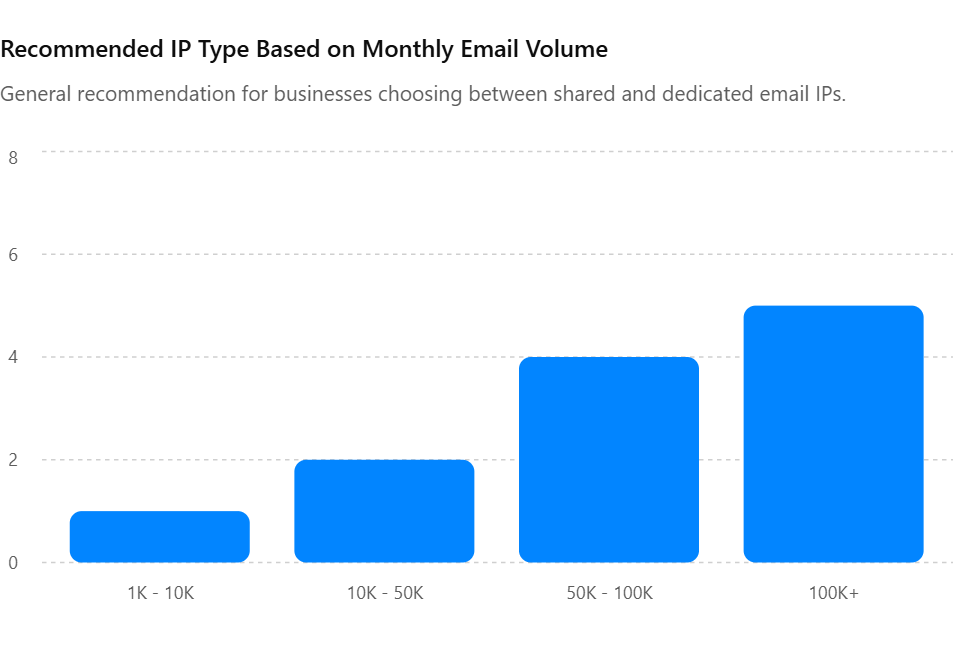
Email Volume Recommendation Chart
Why Businesses Prefer Dedicated IPs for Bulk Email Campaigns
Most professional businesses eventually move toward dedicated infrastructure because it offers:
Better Inbox Placement
Inbox placement is one of the biggest reasons businesses switch to dedicated IPs.
With a dedicated IP:
- Your reputation depends only on your own sending behavior
- Other users cannot affect deliverability
- Email providers can build direct trust in your IP
This often results in:
- Higher inbox rates
- Fewer spam folder issues
- Better campaign visibility
For businesses sending bulk emails regularly, even small improvements in inbox placement can significantly impact revenue and engagement.
Improved Sender Reputation
Dedicated IPs allow businesses to build their own sender reputation over time.
When businesses consistently:
- Send permission-based emails
- Maintain low complaint rates
- Use proper authentication
- Deliver valuable content
Email providers gradually increase trust in the IP.
A strong sender reputation helps improve:
- Deliverability
- Open rates
- Click-through rates
- Customer trust
This becomes a valuable long-term asset for businesses using email marketing extensively.
Higher Email Deliverability
Deliverability is more stable with dedicated IPs because reputation is fully controlled by your business.
This reduces risks caused by:
- Shared server abuse
- Spam activity from other users
- Reputation fluctuations
- Third-party blacklist issues
Professional businesses often choose dedicated IPs because reliable deliverability is critical for:
- Sales campaigns
- Transactional emails
- Customer communication
- Marketing automation
More Control Over Campaigns
Dedicated infrastructure gives businesses greater control over:
- Sending behavior
- Volume management
- Reputation monitoring
- Authentication setup
- Deliverability optimization
This allows businesses to create more advanced and scalable email marketing strategies without relying on shared server limitations.
Businesses can also monitor performance more accurately because all activity belongs only to their own IP.
Better Scalability
As businesses grow, email volume usually increases.
Dedicated IPs are designed to support:
- Large email databases
- High-volume campaigns
- Advanced automation
- Multi-stage workflows
- Frequent promotional emails
This makes dedicated infrastructure more scalable for long-term growth.
Businesses can expand their email marketing operations without worrying about shared environment limitations.
Long-Term Email Stability
Dedicated IPs provide a more stable and predictable email environment over time.
Businesses often experience:
- More consistent inbox placement
- Better reputation management
- Reduced deliverability fluctuations
- Greater infrastructure reliability
For companies heavily dependent on email marketing, this long-term stability is extremely important.
This is especially important for:
- Agencies
- SaaS companies
- E-commerce brands
- Affiliate marketers
- Lead generation businesses
- Bulk email marketers
How DigitalAka Helps Businesses with Bulk Email Infrastructure
DigitalAka provides professional bulk email marketing solutions designed for businesses that need reliable deliverability, scalable infrastructure, and long-term email marketing performance.
For businesses running bulk email campaigns, simply sending emails is not enough. Success in email marketing depends heavily on:
- Inbox placement
- Sender reputation
- Deliverability stability
- Proper authentication
- Server quality
- IP reputation management
DigitalAka helps businesses build a strong and secure email infrastructure that supports high-volume email marketing operations while improving overall campaign performance.
The focus is not only on sending emails, but also on ensuring that emails successfully reach the inbox and maintain a healthy sender reputation over time.
Services Offered by DigitalAka
DigitalAka offers complete email infrastructure and deliverability solutions for businesses of different sizes and industries.
Dedicated SMTP Servers
DigitalAka provides dedicated SMTP servers designed for businesses sending large email volumes.
Dedicated SMTP infrastructure offers:
- Better deliverability control
- Improved sending stability
- Higher scalability
- More reliable performance
Businesses using dedicated SMTP servers often experience more consistent inbox placement compared to shared environments.
Bulk Email Marketing Services
DigitalAka supports businesses with professional bulk email marketing solutions for:
- Promotional campaigns
- Newsletters
- Lead generation
- Customer engagement
- Automated email workflows
- Transactional email communication
The infrastructure is designed to support high-volume email sending while maintaining strong deliverability standards.
Dedicated IP Setup
DigitalAka helps businesses set up dedicated IP infrastructure for improved reputation management and deliverability control.
Dedicated IPs provide:
- Better sender reputation control
- Reduced dependency on shared environments
- More stable inbox placement
- Long-term deliverability improvements
This is especially important for businesses sending bulk email campaigns regularly.
IP Warm-Up Support
Proper IP warm-up is critical for building trust with email providers.
DigitalAka helps businesses gradually scale their sending volume through structured IP warm-up strategies.
This helps:
- Build a positive reputation
- Improve inbox placement
- Reduce spam risks
- Avoid blacklisting issues
A properly warmed-up IP creates a stronger foundation for long-term email marketing success.
SPF, DKIM & DMARC Setup
SMTP authentication plays a major role in email security and deliverability.
DigitalAka assists businesses with:
- SPF configuration
- DKIM setup
- DMARC implementation
These authentication protocols help:
- Verify sender identity
- Prevent spoofing
- Improve sender trust
- Increase inbox placement rates
Proper authentication is essential for professional email marketing operations.
Email Deliverability Optimization
Deliverability optimization is one of the most important aspects of bulk email marketing.
DigitalAka focuses on improving:
- Inbox placement
- Sender reputation
- Engagement rates
- Bounce management
- Spam complaint reduction
The goal is to help businesses maximize the number of emails reaching the primary inbox instead of spam folders.
Inbox Placement Improvement
Many businesses struggle with emails landing in spam folders despite having good campaigns.
DigitalAka works on improving inbox placement through:
- Reputation management
- IP optimization
- Authentication improvements
- List hygiene recommendations
- Deliverability best practices
Better inbox placement can directly improve:
- Open rates
- Click-through rates
- Customer engagement
- Campaign ROI
Email Infrastructure Management
Managing email infrastructure requires continuous monitoring and optimization.
DigitalAka helps businesses manage:
- Server performance
- IP reputation
- Blacklist monitoring
- Deliverability tracking
- Sending behavior optimization
This allows businesses to focus on marketing and growth while maintaining a stable email environment.
Why Businesses Choose DigitalAka
Businesses choose DigitalAka because reliable email infrastructure is essential for successful bulk email campaigns.
DigitalAka focuses on helping businesses:
- Improve sender reputation
- Increase inbox placement
- Scale email marketing operations
- Maintain stable deliverability
- Build long-term email performance
The solutions are designed for businesses that require professional email marketing infrastructure instead of basic shared sending environments.
Industries That Benefit from DigitalAka’s Solutions
DigitalAka’s bulk email infrastructure solutions are useful for:
- Agencies
- SaaS companies
- E-commerce brands
- Lead generation businesses
- Affiliate marketers
- Educational platforms
- Bulk email marketers
- Enterprise businesses
Especially companies that rely heavily on email communication and customer engagement.
Long-Term Focus on Deliverability and Reputation
Email marketing success depends heavily on long-term sender reputation and infrastructure quality.
DigitalAka focuses on building sustainable email systems that support:
- Better deliverability
- Improved trust
- Consistent inbox placement
- Scalable email operations
By combining dedicated infrastructure, authentication, reputation management, and deliverability optimization, DigitalAka helps businesses achieve stronger and more reliable bulk email marketing performance over time.
Conclusion
When comparing Dedicated IP vs Shared IP, there is no one-size-fits-all answer.
A shared IP works well for beginners and low-volume senders.
But businesses running serious bulk email campaigns usually benefit more from dedicated IP infrastructure because of:
- Better control
- Higher deliverability
- Improved reputation
- Stable performance
If your business relies heavily on email marketing, investing in a dedicated IP can improve long-term campaign success.
Frequently Asked Questions (FAQs)
For high-volume email marketing, yes. A dedicated IP gives better control and reputation management.
A shared IP is used by multiple senders, while a dedicated IP is used by only one business.
It can improve deliverability if you follow proper email practices and maintain a clean reputation.
Not always. Shared IPs work well for small businesses and low-volume senders.
Businesses sending bulk emails regularly or requiring strong deliverability should use dedicated IPs.